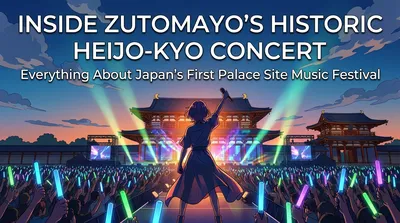
On October 10 and 11, 2026, Japanese music group ZUTOMAYO staged what appears to be their most ambitious concert to date: a two-day outdoor festival at the Heijō Palace Site Historical Park in Nara, drawing more than 70,000 attendees to the ruins of Japan's eighth-century imperial capital. What made this event particularly remarkable wasn't just its scale—it was the unprecedented fusion of contemporary music with one of Japan's most sacred historical landscapes, culminating in vocalist ACAne's emotional message of gratitude to everyone who "met us in this place."
If you've been following the reports and want the fuller picture of what actually happened at this landmark event, we've gathered everything we know about the performances, the venue, the historical significance, and what attendees experienced across those two October days.
The Quick Version

- ZUTOMAYO held a two-day festival called LEGACY ZOMBIE LABO "Bunkadənrai" ("文禍伝雷") at Heijō Palace Site Historical Park in Nara on October 10-11, 2026
- The event drew more than 70,000 people across both days, making it ZUTOMAYO's largest solo concert to date
- Performances took place in the Central Chōdōin area of the ancient palace ruins, reportedly the first large-scale music concert at that ceremonial site
- The reconstructed Daigokuden (imperial audience hall) was illuminated during the show, creating a dramatic backdrop of ancient architecture
- The concert concluded with "Akanesasugoro" ("あかねさす頃"), a special single distributed for the event
Where and When the Concert Took Place
The festival unfolded at the Heijō Palace Site Historical Park, specifically in a temporary outdoor venue within the Central Chōdōin area. For those unfamiliar with the location, this isn't just any park—it's the preserved remains of Heijō-kyō, which served as Japan's capital during the Nara period in the eighth century. The Central Chōdōin was the ceremonial heart of the ancient imperial complex, where the emperor conducted official state business.
Doors opened at 3:30 p.m. on both October 10 and 11, with performances beginning at 5:30 p.m. each day. The concerts were planned to run approximately two hours, with a maximum duration of about two hours and fifteen minutes. This timing meant that as daylight faded, the historic setting became an increasingly dramatic part of the visual experience—something the production team clearly planned for.
What Made This ZUTOMAYO's Biggest Event Yet
ZUTOMAYO has been steadily building their presence in the Japanese music scene, but this event represented a significant leap in scale. The Heijō Palace concerts were positioned as a continuation of their arena tour ZOMBIE CRAB LABO, but the outdoor festival format and the reported 70,000-person attendance across two days marked new territory for the group.
The sheer logistics of staging a contemporary music production at a UNESCO World Heritage site—one that requires careful preservation and respect for its cultural significance—meant this wasn't a typical concert venue. The production had to balance modern sound and lighting requirements with the constraints and sensitivities of performing at an active archaeological and historical site.
According to event reporting, this was the first large-scale music concert held in the Central Chōdōin ruins. While we should note that this claim comes from news coverage rather than an official statement from the site's administrators, it underscores just how unusual this venue choice was. Most concerts of this size take place at purpose-built arenas or established festival grounds—not among the remains of an ancient capital.
How the Ancient Setting Became Part of the Show
One of the most striking aspects of the event was how the production integrated the historical landscape into the performance itself. As the concerts progressed into evening, the site was illuminated, and near the end of each show, the reconstructed Daigokuden—the former imperial audience hall—was lit up.
The Daigokuden reconstruction is a massive structure that gives visitors a sense of the scale and grandeur of the original Nara-period palace. Seeing it illuminated as a backdrop to a contemporary music performance must have created a remarkable visual contrast: modern music and production technology framed by architecture that recalls an era more than twelve centuries past.
The concerts concluded with "Akanesasugoro" ("あかねさす頃"), a single that was distributed specifically for this event. The choice of closing song appears deliberate—the title evokes the reddening sky of sunset, which would have been visible over the ancient palace grounds as the performances reached their climax.
ACAne's Message to the Crowd
During the October 11 performance, ZUTOMAYO's vocalist and principal creative force ACAne took time to express her gratitude—not just to the audience, but to the many people who worked behind the scenes to make the event possible. Her remarks, as reported from the venue, included a particularly heartfelt message: "Thank you—truly, truly—for meeting me in this place."
That choice of words—"meeting me in this place"—carries additional weight given the venue. It acknowledges the effort attendees made to travel to Nara and to gather at this specific, meaningful location. The Heijō Palace Site isn't a convenient downtown venue; it's a deliberate pilgrimage to a place steeped in Japanese history and cultural memory.
ACAne's expression of gratitude to the production crew also reflects the complexity of staging an event at such a location. Beyond the usual concert logistics, the team would have needed to work with cultural heritage officials, address conservation concerns, and plan every technical element around the constraints of a protected historical site.
Understanding ZUTOMAYO's Appeal and Growing Reach
For those less familiar with ZUTOMAYO (ずっと真夜中でいいのに。), the group has built a distinctive presence in Japanese music through ACAne's unique vocal delivery and the project's visual identity. The name roughly translates to "It's Okay to Be in the Middle of the Night Forever," reflecting the group's aesthetic that blends introspective themes with energetic musical arrangements.
What makes the Heijō Palace concert particularly significant is that it demonstrates ZUTOMAYO's ability to draw massive crowds to an unconventional venue. The reported 70,000 attendance figure, while counting both ticketed areas and free-access zones, still represents a remarkable turnout for a two-day event at a location without established concert infrastructure.
The event's title—LEGACY ZOMBIE LABO "Bunkadənrai" (文禍伝雷)—fits with ZUTOMAYO's established naming conventions, which often feature creative wordplay and concepts that resist simple translation. "Bunkadənrai" appears to be a constructed term playing on Japanese and Chinese characters, fitting the theme of performing at an ancient cultural site while maintaining the group's modern, experimental identity.
The Broader Significance of Music at Heritage Sites
While we're focusing on ZUTOMAYO's achievement, it's worth considering what this event represents for the intersection of contemporary culture and historical preservation in Japan. Heritage sites worldwide grapple with the balance between conservation and making spaces meaningful to contemporary audiences.
Staging a modern music festival at the Heijō Palace Site—if done thoughtfully—can introduce younger generations to cultural heritage in a way that feels relevant rather than removed from their daily experience. The fact that more than 70,000 people, many presumably younger fans of contemporary music, spent time at this UNESCO World Heritage site is itself a cultural exchange.
Of course, such events require careful planning to ensure that the concerts don't damage the site or diminish its historical integrity. The temporary nature of the venue in the Central Chōdōin area suggests that organizers took a non-permanent approach that could be dismantled after the event.
What People Are Saying
Fans who attended the concerts have been sharing their experiences on social media, with many emphasizing the emotional impact of the setting. One attendee described watching the Daigokuden light up during the performance as "a moment that made me feel connected to both the present and the ancient past at the same time."
Others focused on ACAne's stage presence and the setlist choices, with several commenting that performing "Akanesasugoro" as the sun set over the palace grounds created an atmosphere they'd never experienced at a typical arena concert. The natural twilight combined with the production lighting appears to have made a lasting impression.
Long-time ZUTOMAYO followers have noted that this event represents a milestone in the group's trajectory, showing their ability to conceptualize and execute an ambitious project that goes beyond standard touring. The choice to hold the concert at a historical site, rather than simply seeking the largest available venue, suggests an artistic vision that considers the meaning and context of where music is performed.
Some attendees from outside Japan shared that they specifically traveled to Nara for the event, combining concert attendance with visits to the broader historical park and surrounding cultural sites. For international fans, the concert became part of a larger cultural experience centered on the ancient capital.
Frequently Asked Questions
When exactly did the ZUTOMAYO Heijō Palace concerts take place?
The two-day event took place on Saturday, October 10 and Sunday, October 11, 2026. Doors opened at 3:30 p.m. both days, with performances starting at 5:30 p.m.
Where is the Heijō Palace Site, and what is it?
The Heijō Palace Site Historical Park is located in Nara, Japan. It preserves the remains of Heijō-kyō, which served as Japan's capital during the Nara period in the eighth century. The concert took place in the Central Chōdōin area, the ceremonial heart of the ancient palace complex.
How many people attended the ZUTOMAYO festival?
The reported attendance exceeded 70,000 people across the two days, counting both the main performance areas and free-access zones within the venue.
Will there be recordings or video of the Heijō Palace performance available?
As of mid-October 2026, details about potential recordings, live albums, or video releases from the event haven't been confirmed. Fans interested in such releases should follow ZUTOMAYO's official channels for any announcements.
What is "Akanesasugoro," the song that closed the concerts?
"Akanesasugoro" (あかねさす頃) is a single that was distributed specifically for the LEGACY ZOMBIE LABO "Bunkadənrai" event. The title evokes the reddening sky of sunset, fitting the timing of the performances as they concluded in the evening.
Looking Back at a Landmark Event
What ZUTOMAYO accomplished on October 10 and 11, 2026, goes beyond the numbers—though 70,000 attendees at their largest solo concert is certainly noteworthy. By bringing contemporary music to the Heijō Palace Site and thoughtfully integrating the ancient setting into the performance, the group created an experience that attendees seem to remember not just as a concert, but as a meaningful encounter between past and present.
ACAne's message of gratitude—thanking everyone for "meeting" in that specific place—captured something essential about what made the event special. The Heijō Palace ruins aren't just a backdrop; they're a place of cultural memory and historical significance, and choosing to gather there for a music festival transforms the experience into something more intentional than typical concert-going.
For ZUTOMAYO, the event marks a clear milestone in their artistic journey, demonstrating their ability to conceptualize and execute large-scale projects that push beyond conventional venues. For those who attended, the illuminated Daigokuden, the setting sun over ancient palace grounds, and the music that filled that space created memories that blend contemporary culture with twelve centuries of history—a meeting, indeed, in a place unlike any other.