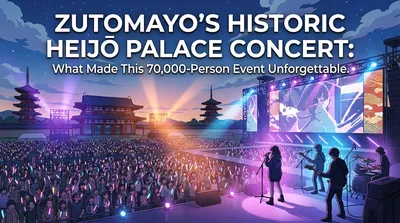
Zutomayo is scheduled to take the stage at one of Japan's most sacred historical sites on October 10 and 11, 2026, in what's being called the first large-scale outdoor music concert ever held at the Heijo Palace Site Historical Park in Nara. The two-day event, titled LEGACY ZOMBIE LABO「文禍伝雷」奈良・平城京, sold out all 65,000 tickets and marks the largest standalone performance in the band's history—but what makes this concert truly remarkable is where it's happening, and why that matters.
We've gathered everything we know about this groundbreaking event, from the practical details fans need to the historical significance of bringing contemporary music to a 1,300-year-old imperial palace site.
The Quick Version

- Zutomayo is scheduled to perform on October 10 and 11, 2026, at the Heijo Palace Site Historical Park in Nara, with doors opening at 3:30 PM and concerts starting at 5:30 PM both days
- All 65,000 tickets sold out across both days, making it the band's largest standalone show ever
- This is the first major outdoor music concert held at the palace site's Central Court Complex, a UNESCO World Heritage location that served as Japan's capital in the 8th century
- The band released a special theme song, "Akanesasu Koro" (「あかねさす頃」), on October 8, 2026, specifically for this concert
- The event extends beyond the concert itself, with food stalls, merchandise areas, workshops, and other festival-style activities planned throughout the day
Why This Venue Is Making History
The Heijo Palace Site isn't just another outdoor concert venue—it's the reconstructed remains of Japan's imperial capital from 710 to 784 CE, a period known as the Nara era when Japanese culture, Buddhism, and the written language flourished. The site is part of the "Historic Monuments of Ancient Nara" UNESCO World Heritage designation, and it has been carefully preserved and partially reconstructed to honor that legacy.
We're witnessing something genuinely unprecedented here. While the broader palace grounds have hosted cultural events before, the Central Court Complex—the ceremonial heart of the ancient palace where emperors once held state functions—has never been the setting for a large-scale contemporary music concert until this weekend. The decision to allow this event required coordination between cultural preservation authorities, park management, and event organizers who needed to ensure the historical site would be protected while accommodating tens of thousands of attendees.
According to official park information, some normal facilities were restricted on October 10 and 11 specifically to accommodate the concert setup and crowd management. This kind of temporary closure underscores how carefully the event needed to be planned—you can't simply roll equipment trucks across archaeological sites without extensive preparation.
What Makes This Zutomayo's Biggest Show Yet
Zutomayo, the music project led by vocalist and creative director ACAne, has built a devoted following since debuting in 2018 with a distinctive blend of rock, pop, and electronic sounds paired with striking animated music videos. The project's mysterious aesthetic—ACAne's face has never been publicly shown—and emotionally intense lyrics have resonated particularly strongly with younger Japanese audiences.
Prior to this Heijo Palace event, Zutomayo had performed at major venues and festivals, but the 65,000-ticket capacity across two days represents a significant milestone. For context, many major Japanese arena tours might see 10,000-15,000 attendees per show, so more than doubling that figure—and selling out completely—demonstrates just how much the band's reach has grown.
The concert is presented as part of the ZOMBIE CRAB LABO touring concept, which has included arena performances earlier in 2026. The Heijo Palace shows, however, carry the special subtitle「文禍伝雷」(roughly "Bunkaden-rai," though translations vary), positioning them as a unique extension of that tour rather than just another stop on the circuit.
The Special Theme Song and Event Experience
Zutomayo released "Akanesasu Koro" (「あかねさす頃」) on October 8, 2026—just two days before the first concert—as the official theme song for the Heijo Palace performances. The title references the warm, reddish light of sunrise or sunset, and "akanesasu" is actually a classical Japanese poetic phrase (makurakotoba) traditionally associated with Nara itself. This kind of deliberate connection between the song and the location shows how thoughtfully the event was designed to honor its setting.
The music video for "Akanesasu Koro" was released alongside the song, giving fans a preview of the aesthetic direction for the concert. While we can't know exactly what the setlist will include until the shows happen, the theme song's release timing suggests it will play a central role in the performances.
Beyond the main concert stages, the event is structured as an all-day festival experience. According to event information, attendees can explore food and merchandise stalls, participate in workshops, and enjoy various side activities throughout the palace grounds. This festival format transforms what could have been a straightforward concert into something more immersive—a full day spent in a historically significant space, surrounded by both ancient architecture and contemporary music culture.
Understanding the Venue's Cultural Weight
For those unfamiliar with Japanese history, it's worth understanding what the Heijo Palace Site represents. This wasn't just any government building—it was the political and ceremonial center of Japan during a transformative period when the country was actively importing and adapting cultural innovations from China and Korea, establishing Buddhism as a state religion, and creating the written systems that would become modern Japanese.
The palace complex originally covered approximately 120 hectares (about 300 acres), with the Central Court Complex—where this concert is taking place—serving as the formal heart where the emperor received ministers and foreign dignitaries. After the capital moved to Kyoto in 794, the palace was abandoned and gradually disappeared under farmland. Archaeological excavations beginning in the 1950s have slowly revealed the palace's foundations, and some structures have been reconstructed based on historical records and archaeological evidence.
When UNESCO designated the site as a World Heritage location in 1998, it recognized not just the physical remains but what they represent: a crucial moment in Japanese cultural development. Hosting a contemporary music concert here, then, isn't just about finding a large outdoor space—it's about creating a dialogue between ancient and modern Japanese culture, between preservation and living use of heritage sites.
The Practical Side: Attendance, Access, and Logistics
Initial announcements projected more than 50,000 attendees across the two days, but that figure appears to have been a conservative early estimate. More recent information indicates that all 65,000 tickets—across every ticket category—sold out in advance of the October 10 opening. The difference between these numbers likely reflects the evolution from initial projections to final ticket inventory, rather than any expansion of the venue.
With doors opening at 3:30 PM and concerts beginning at 5:30 PM on both October 10 and 11, the timing is clearly designed to take advantage of the evening light—remember that "Akanesasu Koro" theme song title referencing sunset hues. Performing at the site where ancient emperors once conducted state ceremonies, as the autumn sun sets over Nara, creates a visual and emotional atmosphere that no indoor arena could match.
The park issued official notices about facility restrictions during the concert dates, warning regular visitors that portions of the site would be inaccessible. For a venue that usually serves as a quiet historical park where families picnic and students study history, accommodating 30,000-plus people each evening requires significant infrastructure—temporary stages, sound systems, lighting rigs, crowd barriers, and all the behind-the-scenes support that modern concerts demand, all installed with care not to damage archaeological remains.
What People Are Saying
The combination of Zutomayo's music and the Heijo Palace setting feels almost surreal—like watching history and the present collide in the best possible way. Getting tickets felt like winning the lottery.
I've visited the palace site for school trips and with family, but never imagined I'd see a concert there. It's going to be strange and wonderful seeing somewhere so quiet and historical filled with music and energy.
"Akanesasu Koro" was absolutely the perfect song choice for this event—the fact that they wrote something specifically connecting to Nara's history shows how seriously they're taking this. It's not just any outdoor concert.
As someone who lives in Nara, I'm genuinely curious how this will work logistically. The palace site isn't designed for massive crowds, and parking is already limited on normal days. But if they pull it off, it could really put Nara on the map as a venue for major cultural events beyond traditional festivals.
Frequently Asked Questions
When exactly are the Zutomayo Heijo Palace concerts happening?
The concerts are scheduled for October 10 and 11, 2026, with doors opening at 3:30 PM and performances starting at 5:30 PM on both evenings.
Where is the Heijo Palace Site located and how do people get there?
The Heijo Palace Site Historical Park is located in Nara city, Nara Prefecture. While specific transportation details for concert attendees haven't been publicly detailed in available information, the site is typically accessible via train stations in Nara, though we'd expect special transportation arrangements given the crowd size.
Are tickets still available for the concerts?
No, all 65,000 tickets across both days sold out in advance of the October 10 opening.
Has any other band or artist performed at this location before?
According to event information, this is the first large-scale outdoor music concert held at the palace site's Central Court Complex specifically. While the broader palace grounds may have hosted cultural programming, a contemporary music concert of this scale at this particular location is unprecedented.
Will the concert be streamed or recorded for people who couldn't attend?
Information about streaming or official recordings hasn't been confirmed in available sources. Fans hoping to experience the concert remotely should watch Zutomayo's official channels for any announcements.
Why This Concert Matters Beyond the Music
We're watching an interesting evolution in how Japan—and perhaps other countries—think about using heritage sites. For decades, the default approach to archaeological and historical locations has been preservation through isolation: keep them pristine, keep them quiet, limit access to protect them. But that approach can also make history feel distant and disconnected from contemporary life.
This Heijo Palace concert represents a different philosophy—one that sees heritage sites as living spaces that can host carefully planned contemporary events without losing their historical dignity. If executed well, it could open the door for other creative uses of historical venues that bring younger generations into contact with their cultural heritage in ways that feel relevant and exciting rather than obligatory.
For Zutomayo specifically, this event positions the band as artists who can command not just large audiences, but culturally significant spaces. That's a different kind of achievement than simply selling out arenas—it suggests respect and trust from cultural authorities who don't make these decisions lightly.
The concerts on October 10 and 11, 2026, represent both a milestone for Zutomayo and a potential turning point for how Japan engages with its historical sites. Whether you're experiencing the concerts in person or following along from afar, we're witnessing something that bridges centuries—the ancient seat of imperial power transformed, for two autumn evenings, into a space where contemporary Japanese music culture can create new memories on ground where history was once made. The sellout crowds and the special theme song rooted in classical Japanese poetry both point to an event that honors where it's happening while looking firmly toward the future.