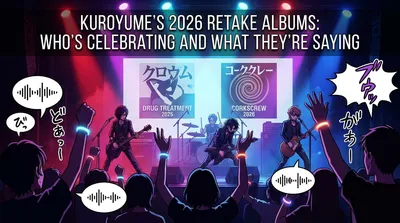
A striking new photo gallery featuring Maximum the Hormone has been making waves among fans of the legendary Japanese rock band, with images captured by concert photographer Kazushi Hamano. The collection offers an intimate look at the four-piece outfit in their element, showcasing the raw energy and intense stage presence that have made them one of Japan's most distinctive musical acts.
For those who've followed Maximum the Hormone's chaotic, genre-defying career, these images provide something we don't always get: a freeze-frame of the band's explosive live performances. Let's explore what makes this gallery special and what it tells us about where the band stands in their remarkable journey.
The Quick Version

- Photographer Kazushi Hamano captured Maximum the Hormone in a gallery that appears to contain 21 images total
- The band's current lineup — Daisuke-han, Nao, Ue-chan, and Maximum the Ryokun — all feature in the photographs
- Hamano has previously documented the band performing signature tracks including "What's up, people?!"
- The images showcase the band's characteristic high-energy stage presence and individual performance styles
- Maximum the Hormone continues to be photographed by concert professionals who specialize in capturing Japan's live music scene
Who Captured These Moments
The photographer behind this gallery, Kazushi Hamano (浜野カズシ), has established himself as a trusted documentarian of Maximum the Hormone's live performances. His work has appeared in multiple concert reports and galleries featuring the band, suggesting an ongoing relationship that allows him unique access to capture their shows.
What makes a concert photographer's repeated access to a band like Maximum the Hormone noteworthy is the trust it implies. We're not talking about posed publicity shots here — these are images captured during actual performances, when the band is at their most uninhibited and authentic. Hamano's lens has been there to freeze those moments when Daisuke-han unleashes his distinctive vocals, when Nao attacks her drum kit with ferocious precision, when Ue-chan anchors everything with bass, and when Maximum the Ryokun's guitar work cuts through the chaos.
Understanding Maximum the Hormone's Visual Appeal
For the uninitiated, Maximum the Hormone might seem like pure pandemonium on stage — and that's not entirely wrong. But there's a method to the madness that photographs can reveal in ways that even video sometimes misses. The band has built their reputation on seamlessly blending heavy metal, punk, pop, and funk into something uniquely their own, and that musical complexity translates into visual dynamism.
Each member brings distinct energy to the stage. Daisuke-han, handling vocals, embodies the frontman role with theatrical intensity. His brother, Maximum the Ryokun, on guitar and additional vocals, provides a contrasting but complementary presence. Ue-chan's bass work grounds the band's wilder impulses, while Nao — who pulls double duty on drums and vocals — represents one of rock music's most compelling performers, male or female, anywhere in the world.
Photographs allow us to see these individual contributions in isolation, something that's nearly impossible when experiencing the full sensory assault of a Maximum the Hormone concert. We can examine Nao's technique, catch the exact moment of Daisuke-han's most extreme expression, or appreciate the physical intensity required to perform this music night after night.
The Band's Enduring Stage Presence
What's particularly striking about contemporary images of Maximum the Hormone is how they've maintained their intensity over the years. Formed in 1998, the band has now been performing together for well over two decades, yet photographs continue to capture the same explosive energy that defined their early years.
This consistency matters because it's rare. Many bands that rely heavily on physical performance either burn out, tone down their approach as they age, or lose key members. Maximum the Hormone has done none of these things. The lineup has remained remarkably stable, and the commitment to putting everything into each performance hasn't wavered.
Concert photography serves as a visual record of this commitment. When we look at images of the band performing songs like "What's up, people?!" — the track that introduced many international fans to their work through its use as a Death Note anime theme — we're seeing documentation of a band that refuses to phone it in.
Why These Images Matter to Fans
For Maximum the Hormone's devoted following, photo galleries serve multiple purposes beyond simple documentation. First, they're souvenirs for those who attended the concerts being photographed — tangible memories of an experience that's otherwise ephemeral. Second, for international fans who may never get the chance to see the band live (Maximum the Hormone tours outside Japan relatively infrequently), these images are the closest thing to being there.
But there's a third function that's worth considering: these photographs help communicate what makes Maximum the Hormone special to potential new listeners. In an era where we discover so much music through playlists and algorithms, seeing a band in full flight can provide context that audio alone doesn't convey. The images answer the question: what kind of people make this music, and what does experiencing it look like?
The fact that professional photographers continue to document the band's performances also signals something about their ongoing relevance in Japan's music scene. Resources get allocated to photograph acts that matter, that draw crowds, that represent something significant in the cultural landscape.
The Technical Challenge of Photographing Maximum the Hormone
From a purely technical standpoint, Maximum the Hormone presents unique challenges for concert photographers. The band's performances involve constant, unpredictable movement, rapid shifts in energy, and often dramatic lighting that can change in an instant. Capturing clear, compelling images under these conditions requires not just skill but deep familiarity with the band's rhythms and patterns.
This is likely why we see the same photographers, like Hamano, repeatedly working with the band. There's a learning curve to photographing any artist, but with a band whose performances are this kinetic, that curve is especially steep. An experienced photographer knows when Nao is about to hit a particularly intense drum passage, when Daisuke-han is building to a vocal climax, when to anticipate the moments worth capturing.
What People Are Saying
The gallery has resonated with fans who appreciate any opportunity to see Maximum the Hormone captured in professional concert photography. Social media responses and comments reveal just how hungry the fanbase remains for new visuals of the band.
"Every photo of this band looks like the best moment of the entire show. How do they maintain that energy for a whole concert?" one fan observed, capturing the seemingly superhuman stamina the band displays.
Long-time followers have noted how the images showcase the band's evolution while maintaining their core identity: "You can see they've matured as performers, but that wild spirit is exactly the same as 20 years ago. That's what I love about them."
For international fans, the photographs take on special significance. As one commenter put it: "Living in Europe, I know I'll probably never see them live. These photos are precious — they're as close as I'll get to understanding what their concerts feel like."
Frequently Asked Questions
Where was this photo gallery originally published?
The specific publication or platform that originally featured this gallery hasn't been definitively confirmed in available sources. The images are credited to photographer Kazushi Hamano and appear to be part of a 21-image collection.
Who are the current members of Maximum the Hormone?
The band's lineup consists of Daisuke-han on vocals, Maximum the Ryokun (Daisuke-han's brother) on guitar and vocals, Ue-chan on bass, and Nao on drums and vocals. This lineup has remained stable for years, contributing to the band's tight, cohesive sound and stage presence.
What is Maximum the Hormone's musical style?
Maximum the Hormone blends heavy metal, hardcore punk, pop melodies, and funk into a distinctive sound that defies easy categorization. Their music is characterized by extreme dynamic shifts, technical proficiency, and a willingness to incorporate humor and pop culture references alongside aggressive instrumentation.
Does Maximum the Hormone tour internationally?
While the band has performed outside Japan on occasion, international tours are relatively rare compared to their domestic concert schedule. This makes documentation of their live performances particularly valuable for fans around the world.
Where can I see more photos of Maximum the Hormone's live performances?
Concert photographers like Kazushi Hamano regularly document the band's performances, with images appearing in various music publications and online galleries. Following the band's official channels and Japanese music photography outlets is the best way to find new images as they're released.
The Lasting Value of Concert Photography
As we move further into an era where everyone has a camera in their pocket and concert footage floods social media, professionally captured images like those in Hamano's gallery remind us why expertise still matters. These aren't shaky phone videos or distant crowd shots — they're carefully composed, technically excellent photographs that capture the essence of what makes Maximum the Hormone compelling.
For a band that's been at this for more than two decades, each new gallery also becomes part of an ongoing visual archive, documenting not just individual performances but the arc of a career. Future fans looking back will have these images to understand what Maximum the Hormone represented, how they connected with audiences, and why they mattered.
Whether you're a devoted fan who's seen the band countless times or someone just discovering their unique brand of controlled chaos, galleries like this one serve a genuine purpose. They freeze moments that would otherwise exist only in memory, and they communicate the physical reality of music-making in ways that recordings alone never can. In Hamano's photographs, we see Maximum the Hormone doing what they do best — and that's something worth preserving.