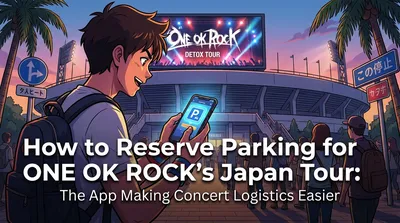
When ONE OK ROCK brought their DETOX JAPAN TOUR 2025 to Oita on August 16–17, 2025, fans driving to the shows found something new waiting for them: an official parking reservation system managed through the akippa app. We're looking at how this approach tackled one of the most stressful parts of attending major concerts — finding somewhere to park — and what it might mean for future tours.
The system represented a shift from the traditional first-come scramble that leaves concertgoers circling unfamiliar neighborhoods, creating traffic headaches for both attendees and local residents. Here's everything we know about how it worked and why organizers made the change.
The Quick Version

- Official parking for the August 16–17, 2025 shows at Kurasu Dome Oita was managed by akippa, a smart parking service app
- Reservations opened on June 28, 2025 at noon, priced at ¥5,000 per vehicle per day
- The system required advance booking through the app — no same-day, walk-up parking was available
- The venue's location, requiring multiple public transit connections, made driving the practical choice for many attendees
- The goal was to reduce traffic congestion from fans driving in circles searching for spots
How the Reservation System Actually Worked
The process started with fans creating an account on akippa's platform well before the concerts. Once reservations opened on June 28, 2025 at noon, users could select their preferred official parking location and the date they planned to attend, complete the payment, and receive confirmation. The entire transaction happened through the app, and spots were allocated on a first-come, first-served basis.
The key difference from typical concert parking: no reservation meant no parking. The system was strictly pre-book only, which eliminated the possibility of showing up and hoping for the best. For ¥5,000 per vehicle per day, attendees locked in a guaranteed spot and could arrive at the venue without the anxiety of not knowing where they'd end up leaving their car.
This approach marked a departure from how most large-scale concerts in Japan have traditionally handled parking. Usually, venues either provide limited on-site parking or leave attendees to fend for themselves in nearby commercial lots and street parking. The result is often predictable chaos: cars circling blocks repeatedly, unauthorized parking in residential areas, and frustrated neighbors.
Why Kurasu Dome Oita Needed a Better Solution
The venue itself created unique challenges that made the parking question more urgent than usual. Kurasu Dome Oita isn't easily accessible by a single train line or bus route. Getting there via public transportation requires transferring between multiple services, which adds time and complexity — especially for fans traveling from other regions who aren't familiar with the local transit network.
When a venue is difficult to reach without a car, attendance by vehicle naturally increases. For a two-day run by a band as popular as ONE OK ROCK, that meant thousands of drivers converging on the same area within a short window of time. Without reserved parking, many of those drivers would arrive without knowing where they could legally park, leading them to cruise surrounding streets repeatedly while searching for an open spot.
That kind of search traffic doesn't just frustrate concertgoers — it creates real problems for the surrounding community. Residential streets see an influx of unfamiliar vehicles moving slowly, turning around, blocking driveways, and sometimes parking illegally out of desperation. The noise and congestion can be disruptive for hours before and after a show.
What akippa Brings to Concert Parking
akippa's business model centers on turning underused spaces into temporary parking. The company partners with property owners — businesses, landowners, even individuals with extra driveway space — to list their spots on the app. For events like concerts and festivals, this means organizers can expand parking capacity beyond what the venue itself offers, tapping into nearby lots and spaces that would otherwise sit empty.
The reservation feature serves a dual purpose. For attendees, it removes the uncertainty and saves time that would otherwise be spent hunting for parking. For the surrounding area, it helps manage traffic flow because drivers aren't adding to congestion by searching — they already know exactly where they're going. Additionally, when the reservation system shows that parking is fully booked, potential attendees can make informed decisions to use public transit or arrange rideshares instead of driving and hoping for the best.
While the concept is straightforward, it's worth noting that the research we've seen doesn't include hard data on how much this specific implementation reduced traffic or improved the experience. The benefits described by the organizers and the service provider are based on the intended design of the system rather than measured outcomes from the Oita shows. The logic is sound — pre-assigned parking should reduce search traffic — but we don't have statistics showing how many fewer cars circled the neighborhood or how much less congested local roads were compared to similar events without the system.
The Trade-offs for Concertgoers
For fans, the system came with both convenience and constraints. On the plus side, anyone who secured a reservation could skip the stress of parking entirely. They knew their spot was waiting, they knew the cost upfront, and they could plan their arrival time without padding extra time for a parking search.
The downside was inflexibility. The ¥5,000 fee had to be paid in advance, and once reservations sold out, driving became far more complicated. Fans who decided late to drive, or who didn't realize the reservation requirement, found themselves with no official options. The surrounding area likely still had some commercial parking, but those lots would fill quickly with overflow from the show, and prices might fluctuate based on demand.
The first-come, first-served nature of the reservations also meant that fans had to act quickly when the booking window opened on June 28, 2025. For a band with a devoted following like ONE OK ROCK, popular time slots and convenient locations could disappear within minutes. This added another layer of planning to the ticket-buying process — not just securing concert tickets, but also racing to reserve parking before it was gone.
What This Means for Future Tours and Events
The Oita shows weren't the first time akippa has worked with major music events, but they represent part of a broader shift in how organizers think about the full fan experience. Parking has always been a logistical challenge for large gatherings, but it's often treated as someone else's problem — either the venue's or the attendees'. Systems like this one attempt to bring parking into the official planning process, treating it as a managed aspect of the event rather than an afterthought.
We're seeing similar approaches at festivals and other multi-day events where parking demand is high and public transit options are limited. The question is whether fans will embrace the trade-off of paying more for certainty, or whether the added cost and planning burden will discourage driving altogether — which, in some ways, might also be a goal for organizers trying to reduce car traffic.
It's also worth watching how these systems handle capacity. If reserved parking becomes standard, venues and promoters will need to balance the number of spots they offer against realistic demand, local road capacity, and the availability of alternative transportation. Too few spots and fans are left scrambling; too many and the surrounding area is still overwhelmed.
What People Are Saying
"Honestly, the parking reservation saved me so much anxiety. I knew exactly where I was going, and I didn't have to circle around for 30 minutes before the show started." — Concert attendee comment shared on social media
"¥5,000 feels steep, but considering how much I would have spent on gas driving around looking for a spot, plus the stress, it was probably worth it." — Fan discussion thread
"I wish I'd known earlier that reservations were required. By the time I tried to book, everything was sold out and I ended up taking the train, which was way more complicated than I expected." — Fan review
"This should be standard for every big concert. Parking is always a nightmare, and having a guaranteed spot makes the whole experience so much smoother." — Comment on concert discussion board
Frequently Asked Questions
Was parking included with concert tickets?
No, parking was a separate purchase. Concert tickets and parking reservations were handled independently, and fans needed to book their parking spot through the akippa app after securing show tickets.
What happened if parking reservations sold out?
Once official parking reservations filled up, fans driving to the venue had to find alternative parking in the surrounding area. This likely included commercial lots and street parking, though availability and pricing for those options weren't guaranteed.
Could you park at the venue without a reservation?
No. The official parking system for these shows was reservation-only. There was no option to purchase parking on the day of the event at the designated official lots.
How far in advance did reservations open?
Parking reservations became available on June 28, 2025 at noon, roughly seven weeks before the first concert on August 16, 2025. This gave fans time to plan their transportation after securing tickets.
Is akippa used for other concert venues in Japan?
akippa partners with various events and venues beyond just this ONE OK ROCK tour stop. The service is designed to work across festivals, concerts, and other large gatherings where parking demand is high, though specific partnerships vary by event.
Looking Ahead: The Concert Parking Puzzle
The reservation system used for ONE OK ROCK's Oita shows in August 2025 offered a structured solution to the perennial problem of concert parking. Fans who planned ahead and secured spots enjoyed a smoother experience, while the surrounding community benefited from reduced search traffic. The trade-offs — upfront cost, advance planning, and limited flexibility — represent the price of that convenience.
As more tours and festivals experiment with managed parking systems, we'll likely see refinements in how they balance capacity, pricing, and accessibility. For now, the Oita model shows that turning parking into a reservable amenity is both possible and, for many attendees, genuinely helpful.
Whether this becomes the standard or remains an option for select venues will depend on how fans respond — and whether the benefits of guaranteed parking outweigh the hassle of yet another thing to book before the show. Either way, the days of simply showing up and figuring it out may be fading for major concert venues.