We're watching something remarkable unfold in J-Pop: three of Japan's biggest music acts—Kenshi Yonezu, YOASOBI, and Fujii Kaze—have announced their largest-ever international tours, bringing dome- and arena-scale performances to cities across Asia, North America, and Europe. These aren't festival appearances or small club shows; we're talking about headline tours at venues that typically host the world's biggest acts.
If you've been following Japanese music's growing international presence, you probably want to know exactly where these artists are heading and what makes these tours different from past overseas appearances. We've gathered the full tour details, venue information, and what this expansion says about J-Pop's place in the global live-music market.
The Quick Version

- Kenshi Yonezu's world tour runs from December 26, 2026, through February 28, 2027, with 14 arena shows across 11 cities on three continents, expecting around 200,000 attendees.
- YOASOBI launched their 10-city Asian dome and stadium tour on October 24, 2026, marking their largest international run to date.
- Fujii Kaze's "Prema World Tour" is scheduled to begin on October 31, 2026, in Kaohsiung, Taiwan, combining major Asian venues with Japanese dome shows.
- All three tours mark a shift from one-off international appearances to fully realized, multi-city headline runs at venues that hold tens of thousands.
- The tours represent Japanese artists increasingly treating international markets as core tour destinations, not just special appearances.
Kenshi Yonezu's Most Ambitious International Run Yet
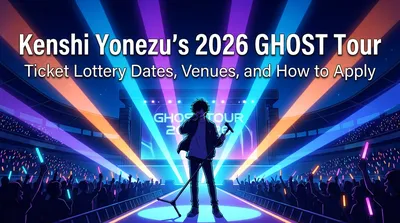
Kenshi Yonezu's "KENSHI YONEZU 2026–2027 WORLD TOUR / GHOST" is scheduled to span three months across three continents, bringing the artist who broke through with "Lemon" and "KICK BACK" to audiences far beyond Japan's borders. The tour is scheduled to run from December 26, 2026, through February 28, 2027, covering 14 performances in 11 cities.
The routing takes Yonezu through Taipei, Seoul, Singapore, and Auckland in Asia-Pacific, then across to Los Angeles, Mexico City, Newark, and Toronto in North America, before finishing with European dates in London, Paris, and Amsterdam. Five of these cities represent first-time destinations for Yonezu, expanding his international footprint significantly beyond his 2025 tour, which covered seven cities with 10 performances.
What stands out most is the venue scale. All 14 international performances are planned for dome or arena-level spaces—the kind of venues that signal an artist has moved from cult following to genuine commercial draw. Organizers are projecting approximately 200,000 total attendees across the tour, making it by far the largest international undertaking of Yonezu's career.
We're seeing an artist who built his reputation through streaming hits and anime theme songs now commanding the same venue tier internationally that major Western pop acts use. For context, Yonezu's breakout single "Lemon" became one of the most-streamed Japanese songs globally, and his "KICK BACK" served as the opening theme for the massively popular Chainsaw Man anime. This tour represents the conversion of that digital reach into physical audiences willing to fill 10,000-to-20,000-seat venues.
YOASOBI Brings "Cho-Wakusei" to 10 Asian Cities
The duo YOASOBI—composer Ayase and vocalist Ikura—kicked off their "ASIA 10-CITY DOME & STADIUM TOUR 2026–2027 'Cho-Wakusei'" (超惑星, or "Super Planet") on October 24, 2026, at Kyocera Dome Osaka. The tour is scheduled to visit 10 cities across Asia using exclusively dome and stadium venues, which represents a significant leap from the theater and small-arena shows that characterized their earlier international appearances.
YOASOBI gained international recognition with "Idol," the opening theme for Oshi no Ko, which became a genuine global hit in 2023. Their narrative-driven pop songs, which turn short stories into music, have built them a devoted international following that extends well beyond anime fans. The decision to tour exclusively in dome and stadium spaces across Asia signals confidence that this fanbase will translate to massive live audiences.
While the complete city list for the tour hasn't been widely detailed in available announcements, the scale alone marks a milestone: we're watching a relatively young act—YOASOBI formed only in 2019—move directly into the top tier of Asian live-music venues. The tour is scheduled to extend into 2027, though specific dates for cities beyond the opening Osaka performance haven't been widely confirmed yet.
Fujii Kaze Combines Japanese Domes with Major Asian Venues
Fujii Kaze's "Prema World Tour" represents a slightly different international model: instead of a pure world tour or Asia-focused run, Kaze is scheduled to combine Japanese dome performances with select major venues across Asia. The tour is scheduled to begin on October 31, 2026, in Kaohsiung, Taiwan, at a stadium venue.
The reported itinerary includes domes in Fukuoka, Osaka, and Tokyo, alongside international stops at the Kaohsiung stadium and a dome in Seoul. This hybrid approach allows Kaze to maintain his Japanese fanbase with the kind of massive hometown shows that solidify an artist's domestic superstar status, while also testing international markets with carefully selected major-venue appearances.
Fujii Kaze built his career through a combination of soulful musicianship, deeply personal songwriting, and a YouTube presence that showcased his piano skills and unique voice. His international following has grown steadily through streaming platforms, and this tour represents the first time he's bringing that digital audience into physical spaces at this scale outside Japan.
What This Wave of Tours Tells Us About J-Pop's Global Position
When we step back and look at these three tours together, we're seeing a clear pattern emerge: Japanese artists are no longer treating international performances as special one-offs or festival appearances squeezed between domestic commitments. Instead, they're building proper multi-city tours using the same venue infrastructure that Western pop, hip-hop, and rock acts have long used for their international runs.
The venue scale matters because it represents a business calculation. Promoters and artists only book 15,000-seat arenas when ticket sales justify it, and these tours suggest that Japanese-language music has reached a commercial threshold in international markets that goes beyond niche appeal. We're not talking about 500-capacity clubs in Little Tokyo neighborhoods anymore; we're talking about the same Los Angeles, London, and Mexico City arenas that host Billboard chart acts.
Each artist is using a slightly different international strategy, which is itself telling. Yonezu is attempting a true cross-continental world tour, the kind of routing that requires significant logistical infrastructure and marketing spend. YOASOBI is focusing intensively on Asia, where geographic proximity and cultural affinity create natural advantages. Fujii Kaze is anchoring his tour in Japan while selectively testing major Asian markets. These different approaches suggest we're watching artists and their teams experiment with various models for how Japanese music works internationally at scale.
The timing also matters. All three tours are scheduled for late 2026 through 2027, which means they're building on several years of streaming growth, pandemic-delayed international appetite, and the proven success of Japanese cultural exports like anime and gaming. The artists aren't pioneering from scratch—they're capitalizing on a moment when international audiences have already been primed to engage with Japanese music through other cultural channels.
What People Are Saying
Music fans across social media have been expressing excitement about finally getting to see these acts live without traveling to Japan. One Tokyo-based fan noted that seeing Yonezu book arenas in Paris and Amsterdam felt surreal, given that just a few years ago international J-Pop concerts outside major cities with Japanese populations were relatively rare.
YOASOBI fans have been particularly enthusiastic about the dome tour, with many commenting that the scale feels appropriate for songs like "Idol" that achieved genuine mainstream visibility internationally. Several fans mentioned they'd been hoping for exactly this kind of commitment to international touring rather than isolated festival slots.
Fujii Kaze's international fanbase, which grew significantly through his YouTube channel, has responded warmly to the tour announcement, though some expressed hope that future tours might expand beyond Asia. For now, many fans in Taiwan and South Korea are simply thrilled to have a nearby option to see him live at all, rather than making the expensive trip to Japan.
Frequently Asked Questions
When exactly is the Kenshi Yonezu world tour?
Kenshi Yonezu's "KENSHI YONEZU 2026–2027 WORLD TOUR / GHOST" is scheduled to run from December 26, 2026, through February 28, 2027, with 14 shows across 11 cities including Taipei, Seoul, Singapore, Auckland, Los Angeles, Mexico City, Newark, Toronto, London, Paris, and Amsterdam.
Where can I find ticket information for these tours?
Specific ticketing details, including on-sale dates and pricing, haven't been widely released in available announcements. We'd recommend checking the artists' official websites and social media channels, as tour promoters typically release ticketing information through those channels several weeks before each tour leg begins.
Are these tours only hitting major cities, or will there be smaller-market dates?
Based on the announced routing, all three artists are focusing on major metropolitan markets and using exclusively arena, dome, or stadium venues. This suggests the tours are designed to maximize audience reach in cities with existing Japanese cultural presence and sufficient fan bases to fill large venues, rather than attempting broader geographic coverage with smaller shows.
Will these tours include stops in South America or Africa?
Kenshi Yonezu's tour includes one Latin American stop in Mexico City, but neither his tour nor the YOASOBI or Fujii Kaze tours currently include dates in South America beyond Mexico, Africa, or the Middle East. The geographic focus appears to be primarily Asia-Pacific, North America, and Europe for now.
Do I need to understand Japanese to enjoy these concerts?
Music transcends language barriers, and all three artists have cultivated international followings despite performing primarily in Japanese. Many fans learn lyrics phonetically or follow along with translations, and the live performance experience—musicianship, staging, energy—connects regardless of language comprehension. That said, familiarity with the artists' music beforehand will certainly enhance your experience.
What This Means for International J-Pop Fans
We're watching a meaningful shift in how Japanese music artists approach international touring, with these three major acts demonstrating that sustained, large-scale tours outside Japan are not only viable but increasingly expected by their global fanbases. The combination of Kenshi Yonezu's cross-continental routing, YOASOBI's Asian dome circuit, and Fujii Kaze's hybrid model suggests that different international strategies can work depending on an artist's specific fanbase geography and career goals.
For fans outside Japan, this wave of tours represents the most accessible opportunity yet to see top-tier J-Pop acts live without international travel. The fact that these artists are committing to proper tour runs—multiple cities, dedicated production, arena-scale shows—rather than one-off appearances suggests they're treating international markets as core parts of their touring business, not afterthoughts.
As these tours unfold from late 2026 into 2027, we'll get a clearer picture of just how large the international appetite for Japanese music really is when tested at this venue scale. The success or challenges these tours face will likely shape how the next wave of Japanese artists approaches international expansion. For now, fans in 20-plus cities across three continents finally have dates to mark on their calendars.