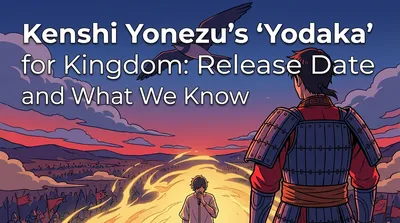
Kenshi Yonezu has released "Ori-Yodaka" (折り夜鷹), a flyable origami craft modeled on the jacket illustration of his latest song "Yodaka" (夜鷹), the theme for the blockbuster film Kingdom: Tamashii no Kessen. Unlike his previous "Ori-Karasu" crow origami that invited fans to fold their prayers, this night hawk is designed to actually soar through the air. We'll walk you through what makes this project special, how it connects to both the film and Yonezu's earlier work, and exactly how you can print and fold your own.
- "Ori-Yodaka" is a printable origami sheet that folds into a night hawk designed to fly when thrown
- Released to commemorate the opening of Kingdom: Tamashii no Kessen, for which "Yodaka" is the theme song
- Available for free home printing or at Seven-Eleven stores across Japan through August 16, 2026
- Follows "Ori-Karasu," Yonezu's crow origami from June that became a social-media phenomenon during the FIFA World Cup
- Marks a conceptual shift from "folding with prayers" to "launching with your own hands"
What "Ori-Yodaka" Actually Is

"Ori-Yodaka" is an origami craft based on the jacket art Yonezu himself drew for his song "Yodaka," which serves as the main theme for Kingdom: Tamashii no Kessen. The project launched on the film's opening day and provides fans with a sheet that combines the decorative base paper with step-by-step folding instructions. What sets this origami apart from traditional paper crafts is its engineering: the night hawk was specifically designed to fly when you throw it, transforming a static piece of art into something kinetic and participatory.
The song "Yodaka" was released digitally on July 13, 2026, and is described as a large-scale rock number built from breakbeats and layered with shinobue (bamboo flute) and other East Asian instruments. The arrangement mirrors the ambition and scope of the Kingdom film series, which has drawn more than 17 million viewers and earned 24.5 billion yen across four installments between 2019 and 2024. By creating an origami version of the song's visual identity, Yonezu extends the world of "Yodaka" beyond sound into something fans can physically hold and launch.
According to official statements, the concept behind "Ori-Yodaka" represents a deliberate evolution from Yonezu's previous origami project. Where "Ori-Karasu" invited supporters to fold a crow and imbue it with their hopes, "Ori-Yodaka" asks us to take flight ourselves—to actively send the bird into the sky rather than simply holding it as a symbol. It's a shift from passive prayer to active participation, and the design reflects that philosophy in its aerodynamic structure.
How "Ori-Yodaka" Builds on "Ori-Karasu"
To fully appreciate "Ori-Yodaka," we need to look at what came before it. In June 2026, Yonezu released "Ori-Karasu" (折り烏), an origami crow based on the jacket art of his song "Karasu" (烏), which was released on June 15, 2026, and served as NHK's soccer theme for the year. The "Karasu" campaign invited fans to fold their own crows and place their prayers for Japan's national team onto them, echoing the familiar image of the senbazuru (thousand paper cranes) but reimagined for the intensity and collective hope of World Cup soccer.
The timing was perfect. As Japan advanced to the knockout stages of the FIFA World Cup, fans across the country folded "Ori-Karasu" birds and shared photos on social media. The images became so widespread that they were mentioned during match broadcasts, turning a music promotion into a participatory cultural moment. The crow—traditionally a symbol of wisdom and observation in Japanese culture—became a vessel for the shared anxiety and hope of millions of supporters watching their team compete on the world stage.
"Ori-Yodaka" takes that foundation and transforms it. While the crow was about collective prayer and stillness, the night hawk is about individual action and flight. The shift mirrors the thematic difference between the two songs and their contexts: "Karasu" was tied to the communal experience of watching soccer, while "Yodaka" connects to the Kingdom protagonist's personal journey from nothing to "Great General of the World." The origami reflects that arc—it's not something you hold and hope over; it's something you launch with your own strength.
A special website titled "Karasu × Yodaka Wild Bird Observation" (烏 × 夜鷹 野鳥観察) has been created where both songs and their bird motifs coexist in a shared virtual sky. The site allows listeners to experience the two tracks as birds moving through one continuous space, visually linking Yonezu's summer 2026 output into a cohesive artistic statement about action, ambition, and the sky as a metaphor for possibility.
Where and How to Get Your Own "Ori-Yodaka"
Printing your "Ori-Yodaka" is straightforward. The origami sheet, which includes both the illustrated base paper and complete folding instructions, is available for free download and can be printed on any home printer. For those who prefer professional printing or don't have access to a printer, the same sheet can be printed at Seven-Eleven multi-copy machines across Japan through August 16, 2026. This dual availability ensures that fans anywhere in the country—or anyone visiting Japan—can participate without needing special equipment.
Once you have the printed sheet, the folding process follows the step-by-step diagrams included on the page. The instructions guide you through creating a night hawk that's not just decorative but functional—engineered to glide when you throw it. The design balances visual fidelity to Yonezu's jacket illustration with the aerodynamic requirements of actual flight, a technical challenge that makes this more than just a promotional giveaway.
After folding, the concept encourages you to take the bird outside and launch it. This physical act—throwing the origami into the air and watching it fly—is the heart of the project. It turns the creation process into a performance, one that echoes the song's themes of ambition and self-determination. You're not folding something to keep on a shelf; you're making something to release, to watch as it takes flight on its own momentum.
The Connection to Kingdom: Tamashii no Kessen
The release of "Ori-Yodaka" coincided precisely with the theatrical opening of Kingdom: Tamashii no Kessen, the latest installment in the massively successful Kingdom film series. The timing wasn't coincidental—the origami project was explicitly framed as a commemoration of the film's premiere. "Yodaka" serves as the movie's main theme, and both the song and the origami reflect the narrative arc at the heart of Kingdom: the rise of an ordinary person to extraordinary heights through will and action.
The Kingdom films, adapted from the long-running manga series, follow characters navigating the brutal politics and warfare of China's Warring States period, with protagonists striving to achieve seemingly impossible ambitions. The night hawk—a bird that hunts in darkness and moves with purpose—becomes a fitting symbol for that journey. By making the origami flyable rather than static, Yonezu transforms a promotional item into a kinetic metaphor: like the film's heroes, the paper bird only realizes its potential when it's set in motion.
The Kingdom franchise has proven to be a cultural phenomenon, with the four films to date drawing a cumulative 17.34 million viewers and earning 24.5 billion yen at the box office. "Yodaka" anchors this latest chapter in sound, while "Ori-Yodaka" gives fans a tangible way to engage with the film's themes before, during, or after watching it in theaters.
What People Are Saying
"I folded Ori-Karasu during the World Cup and now I'm definitely making Ori-Yodaka for Kingdom. Yonezu always finds a way to make his releases feel like events you can participate in, not just consume."
— @musicfan_tokyo on X
"The shift from 'praying over a crow' to 'launching a hawk with your own hands' is such a perfect metaphor. It matches the Kingdom story perfectly—you can't just wish for greatness, you have to make it happen yourself."
— Fan comment on official announcement
"Printed mine at Seven-Eleven this morning. The fact that it actually flies well is impressive—this isn't just a cute gimmick, they really engineered it. My daughter and I spent an hour launching them in the park."
— @origami_enthusiast on social media
"Yonezu's visual concepts are always so thoughtful. The Wild Bird Observation site where Karasu and Yodaka fly together in the same sky is beautiful. These aren't just promotional materials; they're genuine art projects."
— Music blog comment
Frequently Asked Questions
When was "Ori-Yodaka" released?
"Ori-Yodaka" was released on the opening day of Kingdom: Tamashii no Kessen in Japanese theaters. The song "Yodaka" itself was released digitally on July 13, 2026.
Where can I print "Ori-Yodaka"?
You can download and print the sheet at home from the official project website, or print it at any Seven-Eleven store in Japan using their multi-copy machines. The Seven-Eleven printing option is available through August 16, 2026.
Does "Ori-Yodaka" actually fly?
Yes. Unlike traditional decorative origami, "Ori-Yodaka" was specifically engineered to glide through the air when thrown. The design balances the visual appearance of Yonezu's night hawk illustration with the aerodynamic requirements needed for flight.
How is "Ori-Yodaka" different from "Ori-Karasu"?
"Ori-Karasu" (the crow) was designed as something to fold while placing your prayers or hopes onto it, tied to Japan's World Cup campaign. "Ori-Yodaka" (the night hawk) is designed to be actively thrown and flown, representing a shift from passive prayer to active participation that mirrors the themes of the Kingdom film.
Do I need to see the Kingdom movie to appreciate "Ori-Yodaka"?
No. While the origami was released to commemorate Kingdom: Tamashii no Kessen and shares its thematic DNA, "Ori-Yodaka" stands on its own as an art project and interactive craft. You can enjoy folding and flying it whether or not you're familiar with the film series.
Why This Origami Project Matters
"Ori-Yodaka" represents something we don't see often in music promotion: a project that trusts its audience to engage actively rather than passively consume. By providing free printable sheets, making them accessible through convenience stores, and designing something that literally takes flight, Yonezu and his team have created an experience that extends far beyond streaming a song or watching a film. We're invited to make something with our own hands, to send it into the sky, and to participate in the artistic vision rather than just witness it.
The evolution from "Ori-Karasu" to "Ori-Yodaka" also tells us something about how artists can build narrative continuity across projects. The "Wild Bird Observation" website where both birds fly together creates a through-line connecting Yonezu's summer 2026 work, even though one song anchors a global sporting event and the other a historical epic film. The origami projects give physical form to that connection, turning abstract musical releases into tangible objects that occupy the same conceptual space.
For fans outside Japan, the global accessibility of the printable sheet means we can participate even from a distance. While the Seven-Eleven printing option is Japan-specific, anyone with a printer and internet access can download, fold, and fly their own "Ori-Yodaka." That democratic approach to fan engagement—making the experience available to anyone, anywhere, for free—reflects a genuine understanding of how modern audiences connect with art across borders and platforms.
As Kingdom: Tamashii no Kessen continues its theatrical run and "Yodaka" reaches listeners worldwide, "Ori-Yodaka" gives us a way to carry the song's spirit into three-dimensional space. Whether you fold it carefully following every instruction or make it with kids on a summer afternoon, the act of creating and launching your own night hawk turns a music release into a personal memory—exactly the kind of deeper engagement that makes art stick with us long after the promotional cycle ends.